The Grades vs. Comments Trap (The Ruth Butler Experiment)
A famous 1988 psychological experiment proved that the moment you give a child a grade, their brain stops reading your advice. Here is what parents and educators need to know.
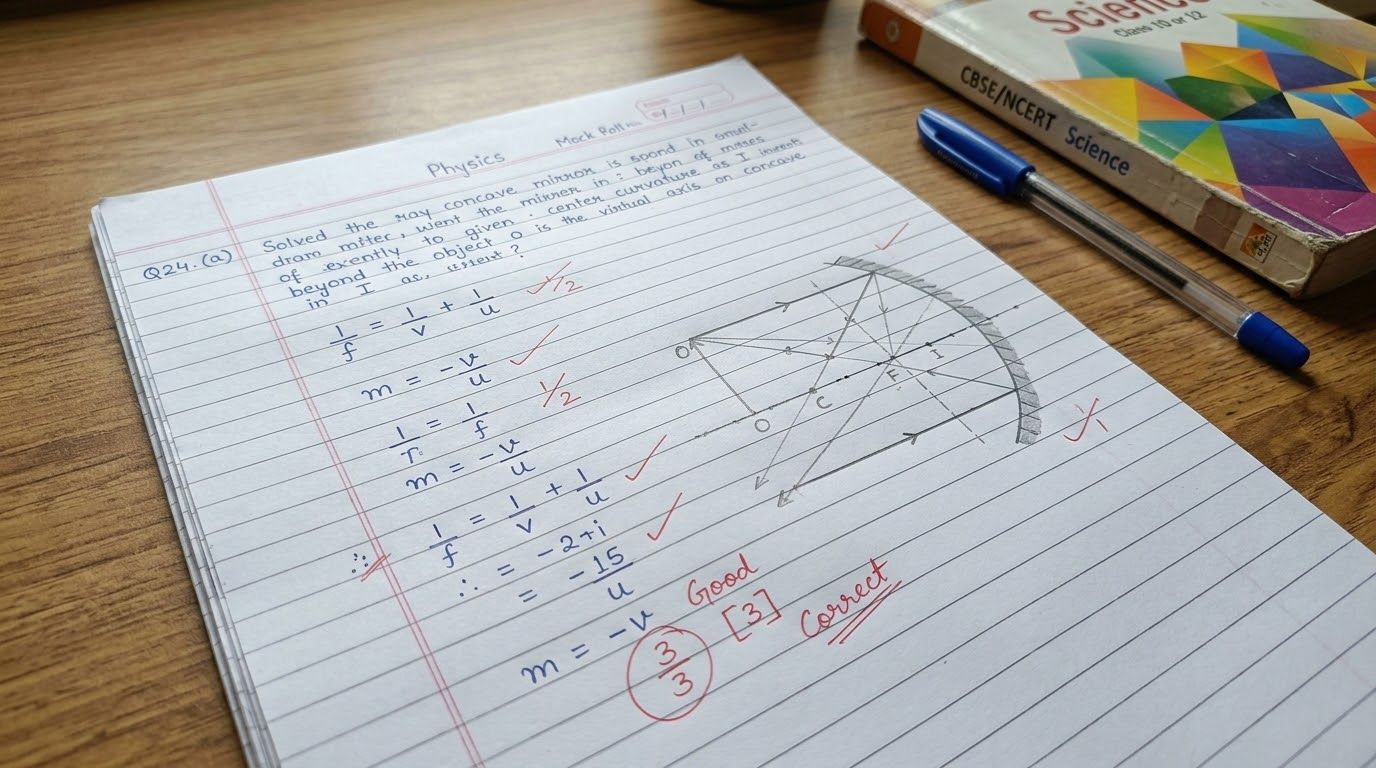
Imagine this scene in an Indian household:
Your child comes home with their latest Class 10 Science test paper. You look at the front page. There is a red circle with “14 / 20” written in thick ink. Beneath it, the teacher has taken the time to write three sentences of careful feedback:
“Good effort in the derivation. You forgot to write the mirror formula before substituting, and your ray diagram lacks arrows. Fix these to gain full marks.”
What does your child do?
Do they read those three sentences, open their notebook, and redraw the ray diagram?
If your home is like 99% of homes, absolutely not.
Your child stared at the number 14, felt a sinking wave of disappointment, wondered what their best friend got, and stuffed the paper into the bottom of their school bag. The teacher’s advice might as well have been written in invisible ink.
For decades, parents and teachers assumed this was simply laziness or teenage defiance. But in 1988, a pioneering educational psychologist named Ruth Butler proved something shocking in a landmark laboratory study:
The moment a student sees a numerical score or a letter grade, their brain literally switches off its ability to process feedback.
The Ruth Butler Experiment: A Lesson Every Parent Must Learn
In her famous study published in the Journal of Educational Psychology, Dr. Ruth Butler divided secondary students into three identical groups. All three groups were given complex problem-solving tasks over multiple sessions.
The only difference was how their work was evaluated:
THE THREE EVALUATION GROUPS

   GROUP A: GRADES ONLY          GROUP B: COMMENTS ONLY        GROUP C: BOTH TOGETHER
   Received a numerical score    Received diagnostic written   Received the score AND
   (e.g., 7/10 or 70%).          comments explaining how to    the diagnostic comments
                                 improve, with NO SCORE.       side by side.
Before looking at the results, ask yourself: Which group do you think improved the most?
Most parents and teachers instinctively guess Group C ("Surely getting both a grade AND helpful comments gives the student the best of both worlds!").
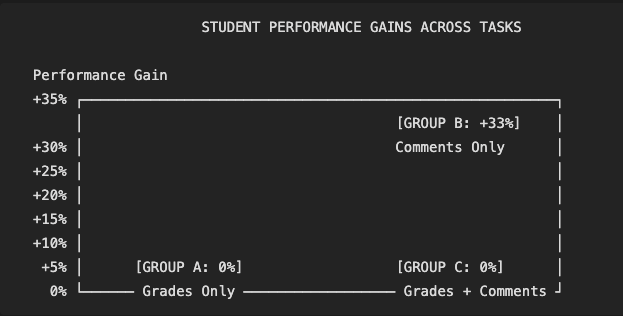
Here is what the empirical data actually showed:
The Shocking Findings:
Group B (Comments Only) achieved a massive 33% improvement in performance. Both previously high-scoring and struggling students improved significantly. Their intrinsic interest in the subject soared.
Group A (Grades Only) showed zero performance improvement. In fact, their interest declined.
Group C (Grades + Comments) performed IDENTICALLY to the Grades-Only group: ZERO GAIN.
Why Grades Cancel Out Good Advice
Why did adding a grade completely destroy the benefits of the comments in Group C?
Cognitive psychologists call this the Ego-Involving vs. Task-Involving Shift.
When human beings are presented with evaluative information, our brains make an instantaneous, unconscious choice about where to direct cognitive resources:
WHEN A GRADE IS VISIBLE: (Ego-Involving)
  The brain asks: "Am I smart or dumb? What will my parents say?
  Did Sharma ji's son beat me?"
  --> The ego activates threat-defense mechanisms.
  --> Anxiety spikes, or pride takes over.
  --> Result: Written diagnostic feedback is 100% ignored.
  ─────────────────────────────────────────────────────────────────
  WHEN ONLY DIAGNOSTIC GUIDANCE IS VISIBLE: (Task-Involving)
  The brain asks: "What is the mechanical gap between what I wrote
  and the standard? How do I fix this formula?"
  --> The prefrontal cortex engages in cognitive problem-solving.
  --> Zero threat to self-worth.
  --> Result: The student executes the fix immediately.
A numerical mark acts like a flashbang grenade to an adolescent's brain. It temporarily blinds them to reason, instruction, and improvement.
The Tragedy of Indian Board Exam Preparation
Now think about how Indian secondary education operates:
Every week, millions of students in Classes 9, 10, 11, and 12 write Unit Tests, Coaching Mock Exams, and Terminal Papers. Almost all of these papers are returned with a big red number at the top.
If the number is high (e.g., 92%), the student feels relaxed and ignores their minor presentation slips.
If the number is low (e.g., 58%), the student feels defensive, ashamed, and anxious.
In both cases, zero learning occurs from the test paper. The student repeats the exact same missing-step habits, the exact same calculation slips, and the exact same diagram errors on the next paper—all the way into the final board examination room.
We spend thousands of crores on tuition, coaching, and sample paper books, yet our grading system actively prevents children from learning from their mistakes.
How Questo Applies the Ruth Butler Principle to Board Prep
At Questo (https://questo.in(), we designed our AI evaluation platform specifically to break this psychological trap:
Step-by-Step Diagnostic Deconstruction First: When your child submits a photo of their handwritten answer sheet, Questo doesn't just slap a single judgmental number on the page. It walks through their work line by line, step by step:
“Your mirror formula is stated correctly (+1 Mark).”
“Deduction on Step 2: Directional arrows missing on incident ray.”
“Your calculation of focal length is mathematically correct.”
Task-Focused, Shame-Free Feedback: Feedback is delivered in a private, objective format. There is no angry red ink, no teacher scolding in front of classmates, and no peer comparison.
Direct Feedforward Actions: Instead of leaving the student with vague disappointment, Questo gives them an immediate, manageable next step:
“Chemistry: Review balancing redox equations on NCERT pages 12–15, then try 5 targeted practice questions.”
Calm Visibility for Parents: For parents, Questo translates the child's work into plain language: what's strong, what's improving, and the exact 20-minute focus topic for the week.
What Parents Can Do Today
If you want your child to stop panicking over marks and start genuinely improving their board exam scores, try this simple experiment at home:
The next time your child gets a marked school test paper back:
Don't ask: “How many marks did you get?” or “Who was the class topper?”
Ask instead: “Show me Question 3. What was the exact step where the examiner deducted marks, and how do we write it according to the textbook?”
Shift the conversation from judgment to diagnosis.
Or better yet, let Questo.in do the diagnosis for you.
👉 Upload your child's handwritten practice paper on Questo.in and experience the power of diagnostic feedback today.
Academic & Experimental References
Butler, R. (1988). Enhancing and undermining intrinsic motivation: The effects of task-involving and ego-involving evaluation on interest and performance. Journal of Educational Psychology, 80(1), 1–11.
Kluger, A. N., & DeNisi, A. (1996). The effects of feedback interventions on performance: A historical review, a meta-analysis, and a preliminary Feedback Intervention Theory. Psychological Bulletin, 119(2), 254–284.
Hattie, J., & Timperley, H. (2007). The Power of Feedback. Review of Educational Research, 77(1), 81–112.
Sadler, D. R. (1989). Formative assessment and the design of instructional systems. Instructional Science, 18(2), 119–144.
Questo Academic Research Group
Parent Pedagogy Team
Research team analyzing diagnostic trends across 15,000+ student handwritten answer scripts.
Related Guides & Articles
The Neuroscience of Exam Anxiety: Why Red Marks Paralyze and How Feedback Heals
When a teenager stares at a test paper covered in red ink, their brain undergoes an evolutionary threat response. Cognitive science explains why traditional grading causes students to shut down—and how diagnostic feedback restores confidence.
Why PTMs Never Tell You Where Marks Slip
You take a half-day off work, wait in a noisy hallway for an hour, and leave with "he needs to practice more." Here is what is actually going on.