The Neuroscience of Exam Anxiety: Why Red Marks Paralyze and How Feedback Heals
When a teenager stares at a test paper covered in red ink, their brain undergoes an evolutionary threat response. Cognitive science explains why traditional grading causes students to shut down—and how diagnostic feedback restores confidence.
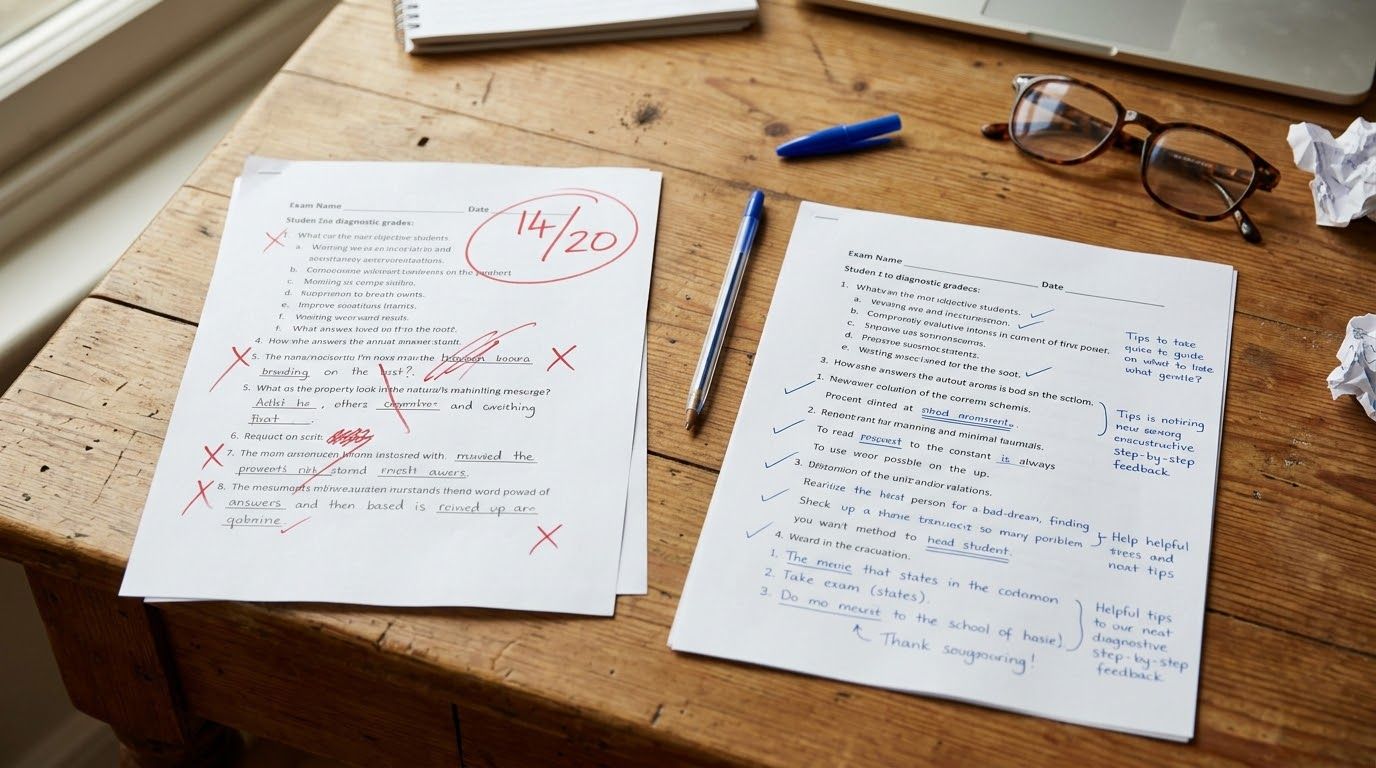
It is 7:30 PM on a Tuesday. Your teenager is sitting at their desk, staring blankly at a test paper they got back from school this morning.
Their Science score was 46 out of 80.
Across the margins, red pen marks are circled like warning flares. In the top corner, two words are scribbled in jagged handwriting: “Very Poor.”
You walk into the room with good intentions:
“Beta, don't worry. Just sit down and solve these questions again. Why aren't you writing?”
Your child sighs, slumps deeper into their chair, and stares into space. An hour later, they haven't written a single word. They seem defensive, irritated, or completely indifferent: “I don't care about this paper anyway.”
As parents, we often interpret this response as laziness, lack of ambition, or stubbornness.
Cognitive neuroscience tells a completely different, heartbreaking story: Your child is not lazy. Their brain is in a state of acute neurobiological paralysis.
What Happens Inside the Brain When a Red Mark Appears
To understand why traditional grading causes teenagers to freeze, we have to look inside the human brain during an evaluation threat.
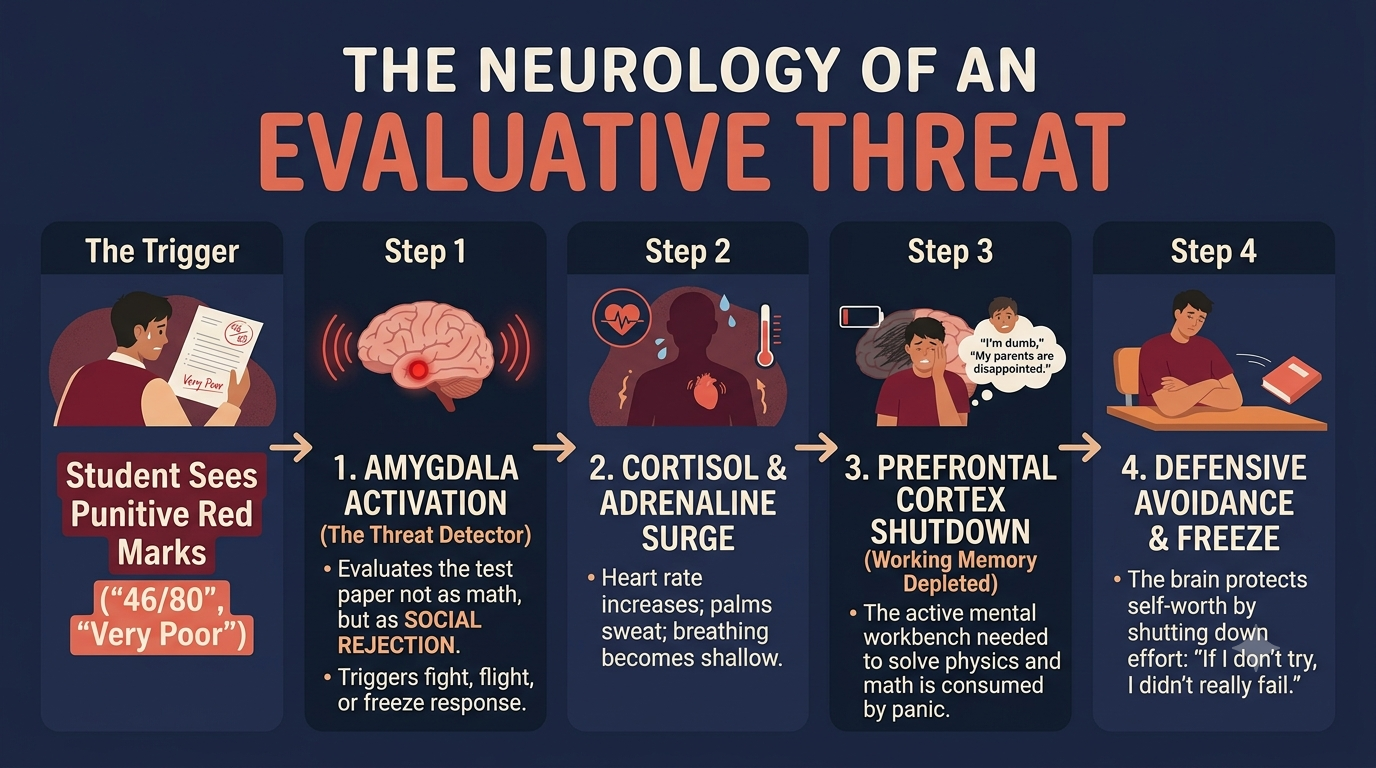
1. The Amygdala Treats Failure as Social Danger
In human evolutionary history, being rejected by your tribe meant physical death. To an adolescent in an Indian household, a disastrous board test result is experienced as profound relational danger:
“My parents made so many financial sacrifices for my coaching.”
“My teacher thinks I’m hopeless.”
“What will everyone say when board results come?”
The brain’s emotional center—the amygdala—does not distinguish between a tiger in the jungle and an angry red cross on a physics paper. It activates an evolutionary threat-defense cascade.
2. Sian Beilock’s Working Memory Choking Effect
Cognitive scientist Sian Beilock (author of Choke) discovered that acute evaluation anxiety literally depletes working memory.
Working memory is the mental scratchpad your child needs to hold variables, carry forward signs, and remember chemical valence numbers. When intrusive worries ("I am going to fail," "What if I get 60%?") flood the prefrontal cortex, there is literally zero cognitive bandwidth left to do math.
The child isn't refusing to solve the problem; their brain physically cannot hold the numbers.
Martin Covington's Self-Worth Protection Loop
When a student realizes that high effort followed by failure equals "I am stupid," they make an unconscious psychological trade: They sacrifice academic success to protect their dignity.
Psychologist Martin Covington (Self-Worth Theory of Achievement Motivation) identified this as the Self-Worth Protection Mechanism:
If I study 8 hours with all my heart and get 50%...
  --> The conclusion is: "I have low intelligence." (DEVASTATING)
  ─────────────────────────────────────────────────────────────────
  BUT if I procrastinate, scroll on my phone, and don't really try...
  --> The conclusion is: "I failed because I didn't study." (SAFE EGO)
Procrastination, indifference, and defiance are not character flaws; they are armor. Your teenager is protecting themselves from the crushing realization that their best effort was not enough.
How Diagnostic Feedback Heals the Brain
How do we disarm the threat response? How do we take a paralyzed student and get their brain back into active problem-solving mode?
Decades of research in educational psychology point to a single solution: Psychological Safety through Criterion-Referenced Diagnostic Feedback.
When feedback shifts from an indictment of the person to an objective inspection of the paper, the brain's response completely reverses:
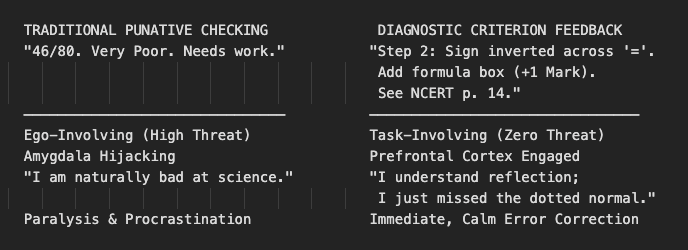
The 3 Rules of Healing Feedback:
Private and Shame-Free: Evaluation must never occur in front of peers, relatives, or angry classrooms. Feedback must be a private dialogue between the student and their work.
Deconstructed, Not Scalar: Never reduce 3 hours of written effort to a single number like "54%." Show them the four procedural buckets: Calculation slips (38%), Skipped steps (21%), Keywords (27%), Presentation (14%).
Finite, Proximal Actions: Never say "study more." Say: "Solve these 5 balancing equations on NCERT pages 12–15." When the target is small and immediate, dopamine replaces cortisol, and learning resumes.
How Questo Rebuilds Exam Confidence
At Questo (https://questo.in), we designed our AI evaluation platform around this exact neuroscience:
Zero Public Embarrassment: Your child writes in their private physical notebook with their own pen. They take a 10-second smartphone photo. No classmates see their mistakes; no teachers scold them.
Objective, Examiner-Level Precision: Questo never says "very poor" or "lazy." It speaks the neutral, objective language of official CBSE marking keys:
“Formula stated correctly: +1 Mark.”
“Deduction: Arrowhead missing on incident ray: -1.0 Mark.”
Restoring Control to the Student: By revealing exactly where marks were lost, Questo transforms a terrifying, mysterious board exam into a manageable, transparent game.
Ending the Family Interrogation: For parents, Questo sends clean, weekly progress reports. You no longer have to interrogate your child at dinner. You can sit down as a supportive mentor and celebrate their step-by-step progress.
A Final Message for Parents
The next time your child looks defeated by a test paper, remember: they don't need a lecture on how important the 10th or 12th board exam is. They already know it. That's why they are anxious.
What they need is clarity. They need to know that their brain is not broken—only their presentation habits need fixing.
Turn off the red pen panic. Turn on diagnostic clarity.
👉 Give your child a calm, confident, shame-free examiner today at Questo.in.
Questo Student Relationships Team
Student Pshycology Specialist
Author of Student Psychology and welfare
Related Guides & Articles
The Grades vs. Comments Trap (The Ruth Butler Experiment)
A famous 1988 psychological experiment proved that the moment you give a child a grade, their brain stops reading your advice. Here is what parents and educators need to know.
Why PTMs Never Tell You Where Marks Slip
You take a half-day off work, wait in a noisy hallway for an hour, and leave with "he needs to practice more." Here is what is actually going on.