Why PTMs Never Tell You Where Marks Slip
You take a half-day off work, wait in a noisy hallway for an hour, and leave with "he needs to practice more." Here is what is actually going on.
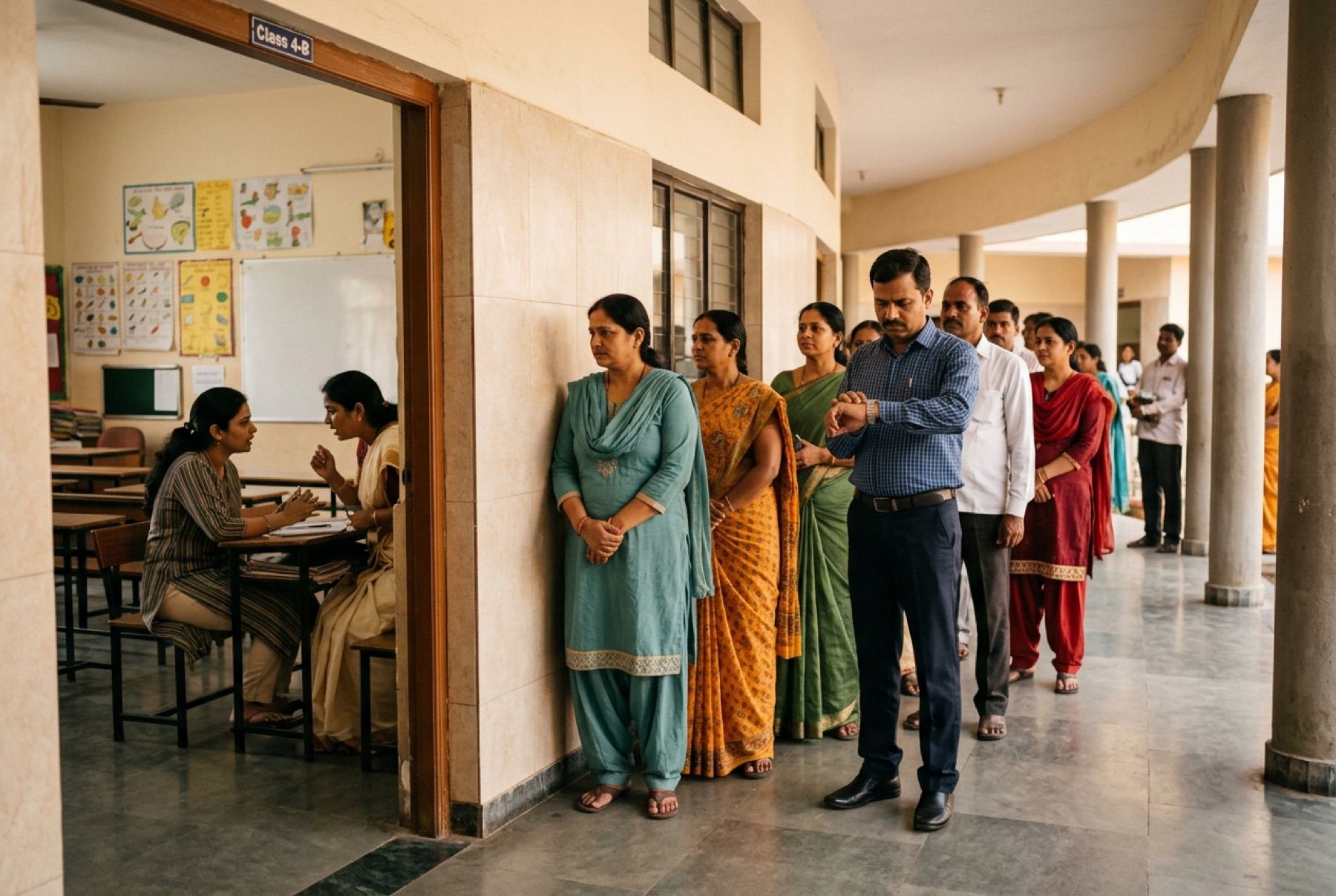
It is Saturday morning. You have rearranged your work schedule, driven through weekend traffic, and found yourself sitting on a wooden bench outside Classroom 10-B.
Around you, thirty other parents are shifting nervously, clutching report cards.
When your name is finally called, you walk in, sit down opposite your child’s Science teacher, and ask the question that has been keeping you up at night:
“Ma’am, his marks in the half-yearly exam dropped from 85% to 68%. What is happening? How can we help him?”
The teacher scans the ledger, smiles sympathetically, and says:
“Aarav is a very well-behaved boy. He is attentive in class. But his concepts in Physics need more work. He just needs to practice more at home.”
Four minutes later, the door creaks open. The next parent is waiting. The meeting is over.
You walk to your car feeling more confused and anxious than when you arrived. What does "practice more" actually mean? Does he practice numericals? Does he re-read the NCERT chapter? Does he need another tuition tutor?
If this scene feels intimately familiar, you are not alone. And more importantly: it is not your fault, and it is not the teacher's fault either.
The Brutal Math of the Indian School System
To understand why Parent-Teacher Meetings (PTMs) fail to give you actionable answers, you only need to look at the numbers.
THE MATHEMATICS OF A TYPICAL PTM
Total Students per Teacher: 120 to 180 (across 3-4 sections)
Allocated PTM Duration: 4 Hours (240 Minutes)
Parents Attending: 35 to 45 per classroom
──────────────────────────────────────────────────────────────────
AVERAGE TIME PER PARENT: 5.3 MINUTES
In those five minutes, the teacher must:
Greet you and exchange pleasantries (1 minute)
Review attendance and classroom behavior (1.5 minutes)
Share the terminal report card grades (1.5 minutes)
Wrap up and call the next parent (1 minute)
Total time left to analyze your child’s 32-page handwritten answer sheet, dissect their derivation errors, and build a personalized revision roadmap: ZERO SECONDS.
School teachers are dedicated professionals, but they are trapped in a system of impossible ratios. They physically do not have the time to conduct an autopsy on every student’s mistakes.
So they rely on the only safe, universal advice available:
“He needs to work hard and practice more.”
Why "Practice More" is Dangerously Flawed Advice
Telling a struggling student to "practice more" without showing them where they are making mistakes is like telling someone with a leaking tire to just "pump more air."
Here is what happens when a student practices blindly:
STUDENT HAS A UNNOTICED HABIT:
  Consistently skips writing the base formula before substituting numbers.

  BLIND PRACTICE ROUTINE:
  Solves 50 extra physics numericals over the weekend.

  THE RESULT:
  They have now reinforced the bad habit 50 consecutive times.
  On board exam day, they lose 1.0 mark on every single question.
When practice is purely quantitative—measured in hours spent at a desk or number of pages written—it does not fix error patterns. In fact, unmonitored practice cements flawed techniques.
What Parents Actually Need: A Weekly Diagnostic Translation
As a parent of a Class 9, 10, 11, or 12 student, you face a second dilemma: the syllabus has outgrown you.
When your child was in Class 4, you could sit with their notebook and point out a spelling mistake or a fraction error. But when your child is in Class 11 studying Electromagnetic Induction or Organic Reaction Mechanisms, you can no longer inspect their work.
You are forced to rely on emotional levers:
"Are you studying?"
"Why are you on your phone?"
"Did you finish your homework?"
This leads to constant household friction, defensiveness, and nagging.
What parents actually need is not a 5-minute meeting twice a year. You need a continuous, plain-language diagnostic translation of your child's written work.
Imagine opening your phone on Sunday morning and seeing this instead of a vague grade:
=========================================
  ANANYA'S WEEKLY DIAGNOSTIC REPORT
  Class 10 CBSE | Physics & Chemistry
  =========================================
  Physics: 82% (Strong)
  Chemistry: 58% (Needs Attention)

  WHERE MARKS WERE LOST THIS WEEK:
  • Calculation Slips:        38% of lost marks
  • Conceptual Gaps:          27% of lost marks
  • Skipped Formula Steps:    21% of lost marks
  • Units & Diagram Labels:   14% of lost marks

  THIS WEEK'S 20-MINUTE FOCUS:
  Chemistry: Balancing Redox Equations.
  Action: Revise NCERT textbook pages 12–15, then solve 5 practice questions.
  =========================================
Suddenly, the conversation completely transforms.
You no longer have to ask: "How was the test?" You can sit down with a cup of tea and say: "Ananya, your Physics derivations are looking great. In Chemistry, it looks like calculation slips cost you 6 marks. Let’s look at NCERT pages 12–15 together for 20 minutes."
From Nagging to Navigating with Questo
At Questo (https://questo.in), we built the platform to give parents clarity and students personalized, examiner-level guidance.
Your child writes on real paper: No laptops, no tablets, zero added screen time.
Snaps a photo with a smartphone: No app to download.
Gets step-by-step examiner feedback: Every line checked against the official CBSE marking scheme.
You get a weekly plain-language report: Actionable, specific, and calm.
Don’t wait three months for the next rushed 5-minute PTM. Give your child a personal board examiner for every answer sheet.
👉 See a sample parent report and try Questo for free at Questo.in.
Questo Academic Research Group
Parent Pedagogy Team
Research team analyzing diagnostic trends across 15,000+ student handwritten answer scripts.
Related Guides & Articles
The Neuroscience of Exam Anxiety: Why Red Marks Paralyze and How Feedback Heals
When a teenager stares at a test paper covered in red ink, their brain undergoes an evolutionary threat response. Cognitive science explains why traditional grading causes students to shut down—and how diagnostic feedback restores confidence.
The Grades vs. Comments Trap (The Ruth Butler Experiment)
A famous 1988 psychological experiment proved that the moment you give a child a grade, their brain stops reading your advice. Here is what parents and educators need to know.