How AI Disarms Exam Anxiety and Builds Structured Learning
When a teenager freezes before board exams, their brain isn't being lazy—it is overloaded. Here is how diagnostic AI turns syllabus chaos into structured calm without adding a single minute of screen time.
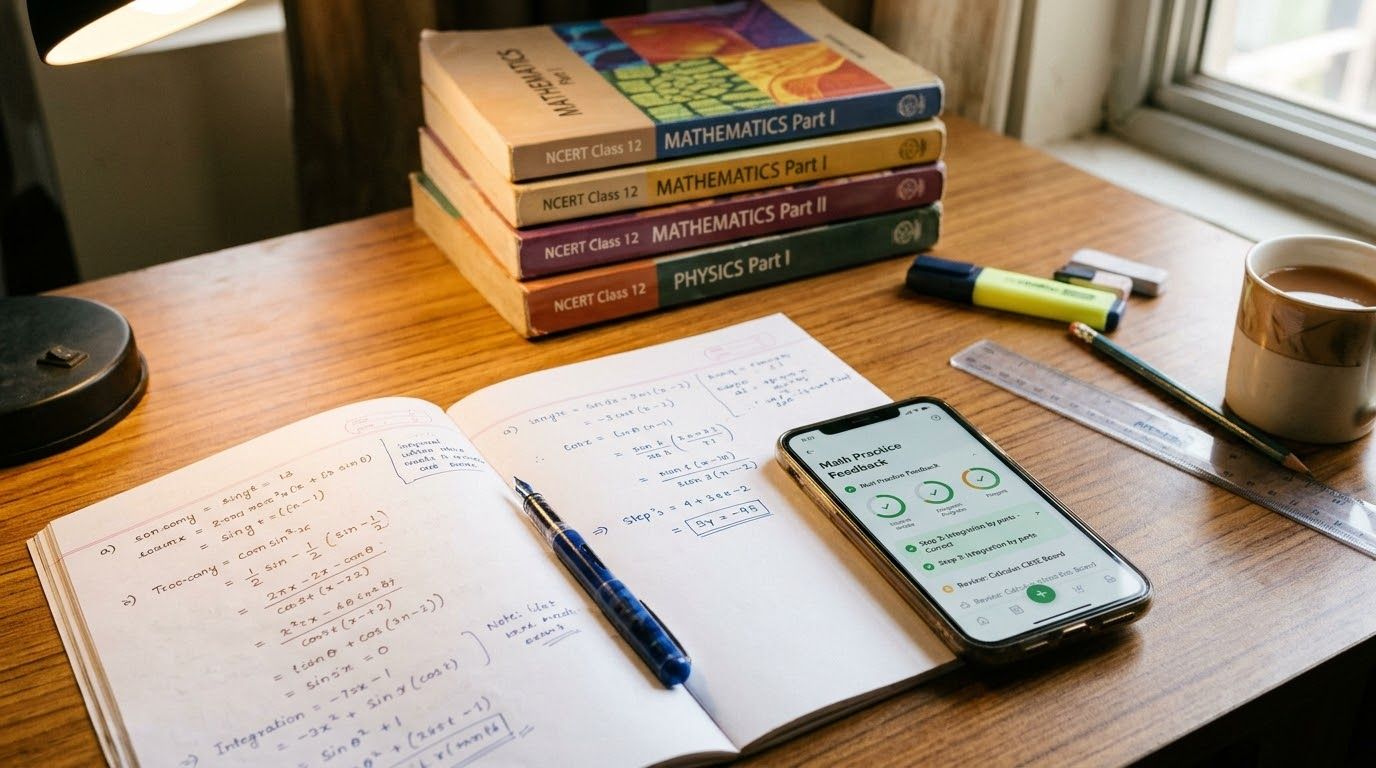
It is 8:15 PM on a Thursday evening in mid-autumn. Across thousands of Indian households, a nearly identical scene is playing out.
Your tenth or twelfth grader is sitting at their study desk, surrounded by a fortress of thick textbooks: NCERT Physics, exemplar problems, sample paper booklets, and tuition binders. Their notebook is open, but the page is practically blank. They have been staring at the same page for forty-five minutes.
You walk into the room with warm intentions:
“Beta, pre-boards are just around the corner. Have you completed the chapter yet? What did you accomplish today?”
Your child doesn’t answer. Instead, their shoulders tense. They snap back defensively: “I’m doing it, okay? Stop constantly monitoring me!”—or they slump into their chair and stare into space with glazed, defeated eyes.
To parents, this looks like procrastination, poor time management, or a lack of seriousness.
Cognitive neuroscience and educational psychology tell a radically different story: Your child is not lazy. Their brain is in acute working memory collapse, paralyzed by the sheer, unstructured ambiguity of the board exam syllabus.
Here is the science of why traditional board exam preparation triggers overwhelming panic—and how diagnostic Artificial Intelligence is fundamentally transforming how students build calm, structured mastery.
The Anatomy of Exam Paralysis: Why Teenagers Freeze
To understand why hard-working students shut down before board exams, we need to look inside the adolescent brain under evaluative stress.
THE NEUROLOGY OF THE "SYLLABUS MOUNTAIN"

  16 Massive Chapters + Unclear Marking + Relational Pressure
                              │
                              ▼
  1. AMYGDALA HYPER-ACTIVATION (EVALUATIVE THREAT)
     • The brain interprets low pre-board scores and parental anxiety
       not as academic metrics, but as relational and social danger.
                              │
                              ▼
  2. WORKING MEMORY DEPLETION (THE "CHOKING" EFFECT)
     • Dr. Sian Beilock's research proves catastrophic worries
       ("What if I don't get 95%?") hijack the prefrontal cortex scratchpad.
                              │
                              ▼
  3. COVINGTON'S SELF-WORTH DEFENSE (AVOIDANT PROCRASTINATION)
     • If I study with 100% effort and fail: "I am stupid" (Devastating).
     • If I procrastinate and don't try: "I failed because I didn't study" (Ego Protected).
                              │
                              ▼
  RESULT: Complete Executive Paralysis, Staring Blankly, and Defensive Indifference
1. Working Memory Choking
Cognitive scientist Dr. Sian Beilock (author of Choke) and researchers Ashcraft & Kirk (2001) demonstrated that anxiety directly drains the working memory capacity of the prefrontal cortex.
Working memory is the mental workbench your teenager needs to keep intermediate equations in mind, carry signs across an equals symbol, and recall valence states. When intrusive panic ("Coaching sir said this paper was easy," "What will relatives say?") consumes 40% of their mental bandwidth, there is literally no room left to calculate.
The student does not forget the formula; their brain physically cannot hold the numbers.
2. John Sweller's Extraneous Cognitive Load
Under Cognitive Load Theory (Sweller, 1988), human working memory can handle only a limited number of elements at once.
When a student is handed a vague directive like "Revise Electricity and Magnetic Effects," the search space is staggering. What should they solve? Derivations? Numericals? Circuit diagrams? MCQs? This ambiguity creates massive extraneous cognitive load. Faced with an incomprehensible cognitive mountain, the brain chooses the path of evolutionary self-preservation: it freezes.
3. The Self-Worth Protection Trap
As educational psychologist Martin Covington (1984) proved, a teenager’s primary psychological drive is to protect their dignity.
In competitive Indian schooling, self-worth is routinely equated with marks. If a child studies with their whole heart and scores 55/80, they feel exposed as "unintelligent." By procrastinating, scrolling on their phone, or claiming "I don't care about this subject anyway," they create a protective psychological alibi: "I didn't fail because I'm dumb; I failed because I didn't study."
The Three Failures of Traditional Board Exam Revision
Why hasn't conventional coaching or extra tuition fixed this? Because most traditional prep methods unintentionally worsen student anxiety:
TRADITIONAL PREP TRAP                  WHAT ACTUALLY HAPPENS INSIDE THE STUDENT
  ┌───────────────────────────────────┐  ┌──────────────────────────────────────────────┐
  │ 1. 10-Hour YouTube "One-Shots"    │  │ Creates the "Illusion of Competence":        │
  │    Passive video marathons        │  │ watching a teacher solve is NOT writing.     │
  ├───────────────────────────────────┤  ├──────────────────────────────────────────────┤
  │ 2. Vague Red-Ink Grading          │  │ "42/80 - Very Poor." Evaluative shaming with │
  │    School & tuition mark sheets   │  │ zero actionable diagnostic direction.        │
  ├───────────────────────────────────┤  ├──────────────────────────────────────────────┤
  │ 3. "Re-read the Entire Textbook"  │  │ Exhausting, demotivating re-reading of 80    │
  │    Blind 15-hour revision cycles  │  │ pages when only 2 formulas were missing.     │
  └───────────────────────────────────┘  └──────────────────────────────────────────────┘
The "Illusion of Competence" from Passive Screen Binging: Students spend hours watching teachers solve questions on YouTube or laptop screens. It feels productive, but research shows recognition is not retrieval (Karpicke & Roediger, 2008). In the real exam hall, when they must write with a pen on empty paper without a screen, their mind blanks out.
Evaluative Shaming vs. Formative Clarity: Landmark experiments by Ruth Butler (1988) proved that numeric grades and punitive scrawls destroy student motivation. When a paper comes back covered in red crosses and a brutal "Very Poor," the ego goes into defense mode, and learning stops.
Additive Revision Fatigue: When a child loses marks, parents and teachers reflexively prescribe more hours: "Solve two more sample paper books," "Re-read all five chapters." The student is already sleeping six hours a night; adding more volume only fuels burnout.
How AI Disarms Anxiety: The 4 Pillars of Structured Learning
Artificial Intelligence—when built specifically for diagnostic evaluation rather than generic video broadcasting—reverses this psychological damage.
Here is how intelligent, criterion-referenced AI evaluation replaces chaos with calm:
HOW AI TURNS EXAM CHAOS INTO STRUCTURED CALM

  CHAOS & ANXIETY:                              STRUCTURED AI MASTERY:
  • "I have 16 chapters left."       ──►        • "Master these 3 specific formulas today."
  • "My teacher thinks I'm weak."    ──►        • "Private, zero-judgment diagnostic audit."
  • "Read 90 pages of NCERT again."  ──►        • "Your concepts are solid; just add units."
  • "Stare at a screen for hours."   ──►        • "Pen-and-paper writing + 15-sec phone scan."
1. Psychological Safety Through Private, Shame-Free Auditing
An AI examiner does not judge, roll its eyes, compare you to a sibling, or sigh in disappointment.
It analyzes an answer sheet with clinical, neutral objectivity:
“Formula stated correctly: +1.0 Mark.”
“Deduction: Missing arrowheads on reflected rays: -1.0 Mark. Rule: See NCERT p. 165.”
Because there is no public embarrassment in a classroom or awkwardness at a parent-teacher meeting, the student’s amygdala remains quiet. Errors are reframed not as personal flaws, but as simple bugs in a procedural code that can be patched in ten minutes.
2. "Subtractive" Learning: Tell Students What NOT to Study
The greatest relief an anxious student can receive is knowing what they don’t have to waste time doing.
Instead of telling a child to re-read an entire 70-page science unit because they scored 52/80, an AI diagnostic audit unbundles their score:
Conceptual understanding: 86% (Solid).
Calculation slips: 8 marks lost (Sign inversion across equations).
Keyword omissions: 4 marks lost (Missing standard NCERT terms).
The prescription is subtractive: "Do not re-read the chapter. Sit down for 15 minutes and complete these four sign-verification drills." Cutting revision time by 60% instantly restores emotional breathing room.
3. Decomposing the Mountain into Proximal Subgoals
Psychologist Albert Bandura (1997) and Dale Schunk (2003) proved that self-efficacy is built through mastery experiences on immediate, attainable proximal subgoals.
Telling an anxious teenager they must jump from 60% to 92% induces panic because the gap feels infinite.
AI breaks the journey down into high-ROI, 2-mark and 3-mark procedural wins:
Today’s Goal: Lock in formula statements in letter notation (+3 marks).
Tomorrow’s Goal: Ensure every physics numerical ends with an SI unit (+2 marks).
Each micro-win delivers a small, natural boost of dopamine, rebuilding genuine academic confidence step by step.
4. The Anti-Burden Workflow: Real Pen and Paper, Zero Screen Distraction
Most EdTech products ask children to spend even more time on tablets and laptops—inviting notifications, eye strain, and parental suspicion.
True board exam preparedness happens in the physical world. The CBSE Board Exam is a 3-hour handwritten marathon.
Under Questo’s anti-burden model, the student remains seated at their physical desk, writing with their real pen on paper.
A smartphone is picked up for exactly 15 seconds to photograph the page, and then put away. The AI audits the handwritten work against the official CBSE Marking Schemes, keeping the student completely shielded from screen fatigue and digital distraction.
Transforming the Dinner Table: From Interrogation to Teamwork
The most profound impact of structured AI diagnosis isn't just higher test scores—it is peace at home.
TRADITIONAL DINNERTIME INTERROGATION         QUESTO DIAGNOSTIC COLLABORATION
  "Did you study today? How many pages?        "I saw Questo's weekly report. Your Ray
  Why did your math teacher say your           Diagrams jumped to 90%! Let's spend 10
  score was low? You need to take this         minutes reviewing the 2 unit slips in
  seriously or boards will be ruined!"         Section C, and then relax."
  ─────────────────────────────────────        ─────────────────────────────────────
  Emotional, adversarial, anxiety-inducing.    Supportive, objective, calm partnership.
When parents receive clean, objective weekly diagnostic reports, they no longer have to guess, interrogate, or play the role of the enforcer. You become your child's calmest cheerleader, armed with facts rather than fear.
A 4-Step Action Plan to Disarm Exam Anxiety Tonight
If your teenager is feeling overwhelmed by their upcoming pre-boards or board exams, take these four immediate steps:
Ban Blind Chapter Re-reading: Stop telling your child to "revise the whole chapter." Take one handwritten practice test they already wrote and identify the exact step where marks leaked.
Anchor Practice to Physical Paper: Do not let them replace writing with watching videos. Even fifteen minutes of active, timed pen-and-paper writing builds more exam-hall endurance than five hours of YouTube lectures.
Focus on the "Low-Hanging 10 Marks": Have them write the formula in letter notation, box final numerical answers, include standard units (\text{m/s}, \text{J}, \Omega), and draw arrowheads on ray diagrams. These procedural habits recover 10 to 15 marks across Math and Science without learning a single new concept.
Give Them an Objective, Private Auditor: Give your child the psychological safety of an objective examiner that checks their work without judgment.
The Questo Promise: Calm, Confident Board Preparation
At Questo (https://questo.in), we built our AI platform on a simple truth: Hard-working students shouldn't lose marks to presentation traps, and families shouldn't lose their peace of mind to exam anxiety.
Your child writes on real paper. They snap a quick photo. Within minutes, Questo audits their work step by step against official CBSE rubrics, showing them exactly where marks leaked and the precise two textbook pages to review.
Turn off the panic. Turn on structured clarity.
👉 Experience calm, shame-free diagnostic evaluation for your child at Questo.in.
Academic & Institutional References
Beilock, S. L. (2011). Choke: What the Secrets of the Brain Reveal About Getting It Right When You Have To. Free Press / Simon & Schuster.
Ashcraft, M. H., & Kirk, E. P. (2001). The relationships among working memory, math anxiety, and performance. Journal of Experimental Psychology: General, 130(2), 224–237.
Sweller, J. (1988). Cognitive load during problem solving: Effects on learning. Cognitive Science, 12(2), 257–285.
Covington, M. V. (1984). The self-worth theory of achievement motivation: Findings and implications. The Elementary School Journal, 85(1), 4–20.
Butler, R. (1988). Enhancing and undermining intrinsic motivation: The effects of task-involving and ego-involving evaluation on interest and performance. Journal of Educational Psychology, 80(1), 3–14.
Karpicke, J. D., & Roediger, H. L. (2008). The critical importance of retrieval for learning. Science, 319(5865), 966–968.
Bandura, A. (1997). Self-Efficacy: The Exercise of Control. W. H. Freeman and Company.
Schunk, D. H. (2003). Self-efficacy for reading and writing: Influence of modeling, goal setting, and self-evaluation. Reading & Writing Quarterly, 19(2), 159–172.
Central Board of Secondary Education. (2025). Handbook of Assessment and Evaluation. CBSE Academic Branch, New Delhi.
Questo Student Relationships Team
Student Pshycology Specialist
Author of Student Psychology and welfare
Related Guides & Articles
The Neuroscience of Exam Anxiety: Why Red Marks Paralyze and How Feedback Heals
When a teenager stares at a test paper covered in red ink, their brain undergoes an evolutionary threat response. Cognitive science explains why traditional grading causes students to shut down—and how diagnostic feedback restores confidence.
The Grades vs. Comments Trap (The Ruth Butler Experiment)
A famous 1988 psychological experiment proved that the moment you give a child a grade, their brain stops reading your advice. Here is what parents and educators need to know.
Why PTMs Never Tell You Where Marks Slip
You take a half-day off work, wait in a noisy hallway for an hour, and leave with "he needs to practice more." Here is what is actually going on.